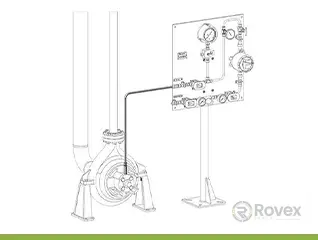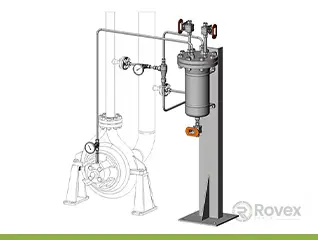
We manufacture high-performance seal support systems that improve the efficiency, reliability, and lifespan of mechanical seals. Designed to meet industry standards, our systems help reduce downtime and maintenance costs.
Mechanical seals are only as reliable as the systems that support them. Our API 682-compliant Seal Support Systems deliver consistent cooling, lubrication, and barrier/buffer fluid management to protect your rotating equipment from premature seal failure, unplanned downtime, and costly product loss — across pumps, mixers, agitators, and compressors in the toughest process environments.
From standard API Plans to fully custom-engineered skids, we combine 25+ years of sealing expertise with rigorous quality control to extend seal life, reduce maintenance costs, and keep your plant running safely and continuously.
| Feature | Customer Benefit |
|---|---|
| API 682 Compliant Design | Assured compatibility with global standards, EPC specifications, and OEM requirements. |
| Reliable Cooling System | Prevents seal face overheating, reducing thermal degradation. |
| Continuous Lubrication Control | Maintains stable fluid film, minimizing dry-running risk. |
| Pressure & Temperature Instrumentation | Enables early detection of abnormal seal conditions. |
| Corrosion-Resistant Materials | Longer equipment life in aggressive or corrosive services. |
| Custom Engineering | Precise fit for unique process conditions, reducing retrofit costs. |
| Compact Skid Design | Saves plant space and simplifies installation. |
| Easy Access for Maintenance | Reduces mechanical downtime during inspections and servicing. |
| Reduced Fugitive Emissions | Supports environmental compliance and worker safety. |
| Extended Seal & Pump Life | Lowers total cost of ownership and spare parts consumption. |
| Fast Fault Diagnosis | Minimizes unplanned shutdowns through real-time monitoring. |
| Application-Specific Fluid Selection | Optimized performance across diverse process media. |
Our advanced seal support systems are designed to maximize the performance and reliability of mechanical seals. Built for demanding industrial applications, they help reduce downtime and extend equipment life.

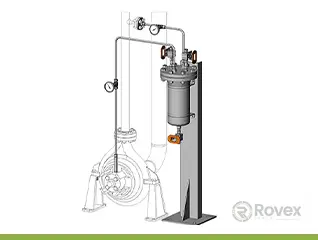
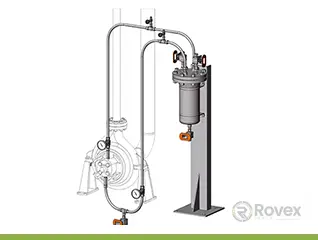
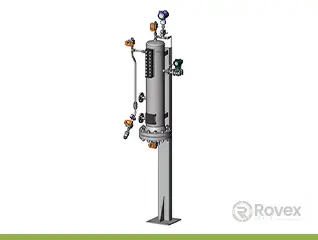
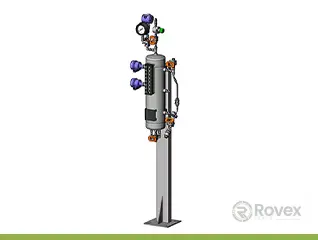
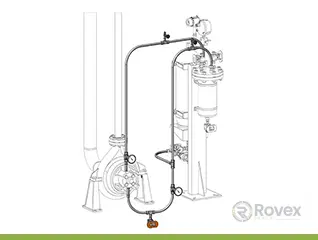
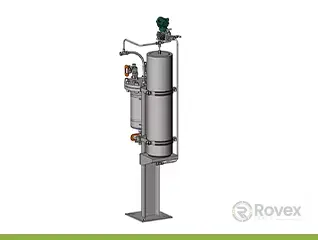
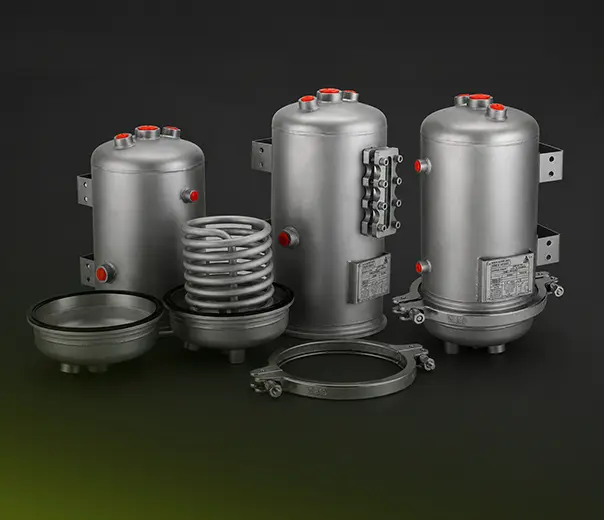
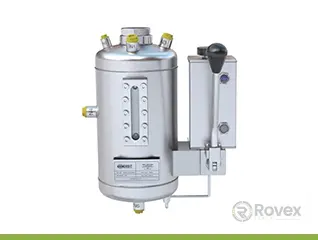
Thermosyphon VESSEL Series is basically used as a storage & pressurizing unit. This is used for double mechanical seals in back to back or tandem seal arrangement to provide necessary lubrication and cooling to the seal faces to achieve recommended seal life. This is equipped with cooling coil inside the shell to bring down the temperature of barrier fluid coming from seal to Thermosyphon feature of this heat exchanger is that its cooling coil can be removed for cleaning purpose. Water retention systems are connected directly to a suitable clean water supply to form a low maintenance, high reliability barrier fluid system. In normal operation the supply pressurises the vessel, but negligible water is drawn

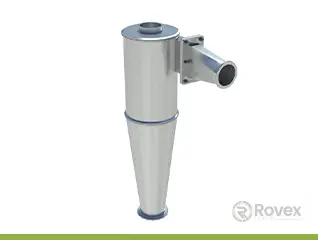
Cyclone separator is a Mechanical device either machined or cast in structure. The lower body and the upper body is sealed with an elastomeric O-ring and is connected with the help of studs and nuts. The internal diameter of the cyclone separator gradually tapers down. It has three ports – inlet, outlet, drain.

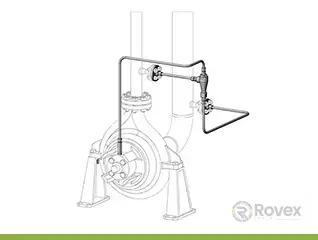
Similar to Plan 11 but includes a cooler to reduce fluid temperature before it reaches the seal.
Process fluid is throttled through an orifice and passed through a heat exchanger before entering the seal chamber.
Hot process services where fluid temperature exceeds safe seal operating limits.
Effective temperature control for hot service pumps without external fluid sources.

Provides efficient cooling for hot services using a closed-loop recirculation system with minimal makeup fluid.
A pumping ring circulates a small trapped volume of seal chamber fluid through an external cooler and back.
High-temperature services such as boiler feed water and hot hydrocarbon pumps.
Highly efficient cooling with low fluid consumption; widely used for hot water and steam services.

Removes solids from the seal flush fluid using a cyclone separator before reaching the seal.
A cyclone separator uses centrifugal force to separate heavier solids from the flush fluid, directing clean fluid to the seal and solids back to suction.
Slurry or solids-laden services such as mining, mineral processing, and pulp handling.
Protects seal faces from abrasive particles without external fluid injection.

Injects a clean external fluid directly into the seal chamber to flush out process contaminants.
Dirty, abrasive, or polymerizing process fluids where internal flushing is inadequate.
Reliable contamination control for difficult, solids-laden, or hazardous media.

Combines cyclone separation (Plan 31) with cooling (Plan 21) for hot, solids-laden services.
Process fluid passes through a cyclone separator for solids removal, then through a cooler before reaching the seal.
Hot slurry and abrasive process services requiring both cooling and particulate control.
Dual protection against thermal and particulate seal damage.

Provides an unpressurized buffer fluid reservoir for dual unpressurized (tandem) seal arrangements.
A buffer fluid circulates between the seal chamber and reservoir at a pressure lower than process pressure, using a thermosyphon or pumping ring; a vapor recovery/vent line manages leakage.
Hydrocarbon and volatile process services requiring secondary seal containment.
Protects atmosphere-side seal and provides leakage monitoring without full containment pressure.

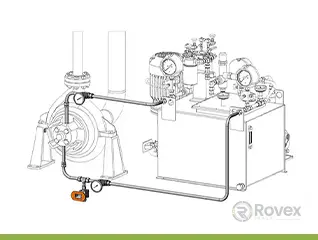
Supplies a pressurized barrier fluid using a pressurized reservoir with gas overpressure for dual pressurized seal arrangements.
An inert gas blanket pressurizes the barrier fluid reservoir above process pressure, ensuring barrier fluid leaks into the process rather than process fluid escaping.
Standard dual pressurized seal applications across general process industries.
Simple, proven pressurization method with reliable containment.

Uses a bladder-type accumulator to maintain barrier fluid pressure for dual pressurized seals.
A pre-charged bladder accumulator maintains consistent barrier fluid pressure above process pressure without continuous gas consumption.
Applications requiring stable pressure with reduced nitrogen/gas usage, including offshore and remote sites.
Lower gas consumption, more stable pressure response to system transients.

Uses a piston-type accumulator with process-pressure tracking to maintain barrier fluid pressure.
A piston accumulator automatically tracks and maintains a fixed pressure differential above fluctuating process pressure.
Services with significant or frequent process pressure fluctuations.
Automatic pressure tracking ensures consistent barrier fluid differential under variable conditions.

Supplies pressurized barrier fluid from an external, plant-wide circulation system rather than a dedicated local reservoir.
Barrier fluid is supplied and returned via a central pressurized system serving multiple seals across the plant.
Large process units and refineries with multiple dual-seal pumps requiring centralized barrier fluid management.
Centralized monitoring and reduced footprint for individual equipment.